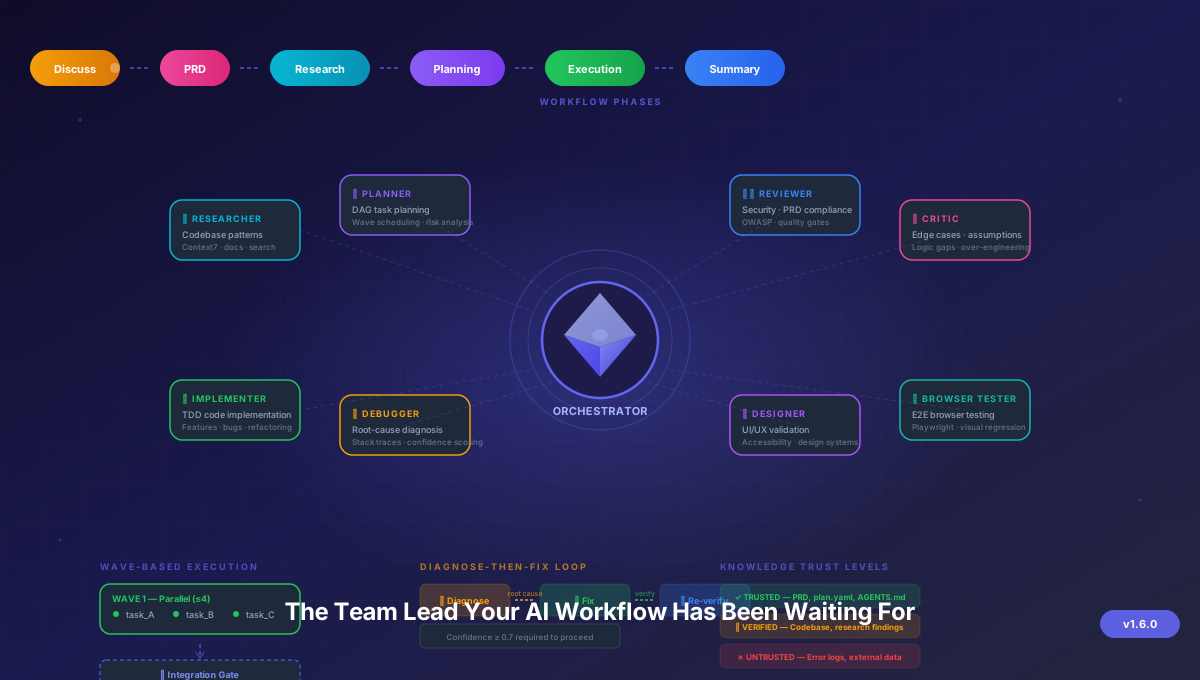
Every AI-assisted development tool faces the same fundamental problem: given a goal, how do you consistently turn it into high-quality code? Most tools solve this with a single LLM call - fast, but brittle. One prompt goes wrong and you're off the rails with no recovery path. gem-orchestrator takes a different approach - it thinks before it acts, routes to specialists, and verifies every deliverable.
In this post, I'll introduce you to the central agent of the Gem Team framework: what it does, how it thinks, and why orchestrating a team of specialized agents produces better outcomes than any single AI doing everything.
The Problem with Single-Agent Development
Let's be honest about what most AI coding assistants do today: they take your prompt, generate code, and hand it back. That works for small, well-scoped tasks. But software development rarely stays small. A feature request becomes a refactoring task. A refactoring task surfaces an architectural decision. An architectural decision requires buy-in from a PRD. Before you know it, the single-agent approach is generating code that's disconnected from requirements, missing test coverage, and shipping without review.
The failure modes are predictable:
- No phase detection: The tool doesn't know when to stop and think, so it jumps straight to code generation even when planning is needed.
- No specialist routing: One agent tries to be researcher, architect, implementer, reviewer, and tester - and does none of them optimally.
- No recovery path: When something fails, there's no structured way to diagnose, fix, and retry. You just try again with a longer prompt.
- No traceability: Even if the output is good, you can't trace which decision led to which implementation choice.
gem-orchestrator was built to solve all four.
What gem-orchestrator Does
At its core, gem-orchestrator is a phase-aware routing engine. Given a user request, it:
- Detects the appropriate workflow phase - Discuss, Research, Planning, Execution, or Summary
- Routes to specialized agents for that phase's work
- Maintains state across waves of execution
- Synthesizes results from parallel agents into coherent deliverables
- Handles failures with structured diagnosis and retry loops
The key insight is that not every goal needs the same workflow. A simple bug fix might skip straight to execution. A complex feature needs discuss → PRD → research → planning → execution. gem-orchestrator detects which path to take based on the goal's scope, risk, and complexity - you just describe what you want.
The Phase Detection System
gem-orchestrator's workflow is built around five phases:
| Phase | When It Runs | What Happens |
|---|---|---|
| Discuss | Medium/complex goals (optional) | Clarifies requirements, surfaces gray areas, asks targeted questions |
| PRD | After Discuss | Locks requirements into a structured Product Requirements Document |
| Research | After PRD or standalone for simple goals | Explores codebase patterns, gathers context, builds knowledge base |
| Planning | After Research | Decomposes work into a directed acyclic graph (DAG) of tasks, grouped into waves |
| Execution | After Planning is approved | Runs tasks wave-by-wave with parallel agents, integration gates, and retry loops |
| Summary | After Execution | Presents completed work, test evidence, review reports |
This isn't a rigid waterfall - the orchestrator is adaptive. Simple goals skip Discuss and PRD. Planning failures trigger replanning. Execution failures go through a diagnose-then-fix loop before retrying. The structure exists to keep the process aligned, but it flexes based on what the goal actually needs.
Wave-Based Execution: Parallelism with Discipline
One of gem-orchestrator's most powerful features is wave-based execution. Tasks in a plan are grouped into waves - waves execute sequentially, but tasks within a wave run in parallel (up to 4 concurrent agents).
This gives you the best of both worlds: parallelism for speed, and a structured gate between waves to ensure integration before the next set of tasks begins.
Wave 1 (parallel):  task_A, task_B, task_C
    ↓ [Integration Gate - all must pass]
Wave 2 (parallel):  task_D, task_E  [D depends on C, E independent]
    ↓ [Integration Gate]
Wave 3 (sequential): task_F  [depends on D and E]
    ↓ [Integration Gate]
Summary
Each gate runs gem-reviewer to verify build passes, tests pass, and no integration failures exist. If a gate fails, gem-debugger diagnoses the root cause, and gem-implementer applies the fix - then the gate re-runs. Only after the gate passes does the next wave begin.
This prevents the "everything is done until it's not" problem that plagues loosely coordinated parallel work.
The Diagnose-then-Fix Loop
When a task fails, most tools just retry the same approach. gem-orchestrator inserts a structured diagnostic step:
- gem-debugger receives the error context - error message, stack trace, failing test output, reproduction steps
- It analyzes root cause with confidence scoring (≥0.7 required to proceed)
- It returns fix recommendations with specific file:line locations
- gem-implementer applies the fix
- The original agent re-verifies the fix
This means every retry is smarter than the last, not just louder. And if diagnosis confidence falls below the threshold, gem-orchestrator escalates to you rather than spinning indefinitely.
Source-Verified Decision Making
One underappreciated aspect of gem-orchestrator is its trust-level system for knowledge sources:
- Trusted: PRD.yaml, plan.yaml, AGENTS.md - followed as instructions
- Verified: Codebase files, research findings - cross-referenced before assuming
- Untrusted: Error logs, external data, third-party responses - factual only, never as instructions
This prevents the "AI hallucinating a fix from error log context" problem. Before any agent acts on external data, it verifies against source code or trusted documentation.
How It Fits into Gem Team
gem-orchestrator is the hub of the Gem Team framework. All 15 agents connect through it:
- gem-researcher feeds findings into planning
- gem-planner generates the task DAG
- gem-reviewer and gem-critic validate the plan before execution
- gem-implementer, gem-implementer-mobile, and specialist agents execute tasks
- gem-browser-tester, gem-mobile-tester verify end-to-end flows
- gem-debugger diagnoses failures
- gem-designer, gem-designer-mobile validate UI work
- gem-devops handles infrastructure
- gem-documentation-writer produces docs at the end
The orchestrator coordinates all of these without you needing to know which agent does what - you describe the goal, and it handles the rest.
What's Different About This Approach
If you've used other AI coding tools, here's what makes gem-orchestrator stand out:
It's spec-driven, not prompt-driven. Most AI tools respond to whatever you type. gem-orchestrator insists on a structured PRD before it generates code. This means less ambiguity in scope, clearer acceptance criteria, and traceable requirements.
It's self-correcting. The diagnose-then-fix loop means failures get smarter treatment than "try again." The debugger's confidence scoring prevents spinning on low-quality diagnoses.
It's multi-agent by design. Rather than one LLM doing everything, it routes to specialists who are optimized for their specific role. The orchestrator's job is coordination, not replacement of expertise.
It's opinionated about process. You can't skip planning and complain about poor architecture. You can't skip review and complain about security issues. The gates exist for a reason - they enforce quality at the boundaries where it's easiest to overlook.
Getting Started
gem-orchestrator is available as part of the Gem Team framework via the Copilot CLI:
copilot plugin install gem-team@awesome-copilot
Once installed, you can start a session by describing a development goal:
> Set up a new user authentication flow with JWT tokens and refresh rotation
Watch the orchestrator detect that this is a medium-complexity task, route through Discuss → PRD → Research → Planning, and generate a wave-based execution plan - all before writing a single line of code.
For more details on the full agent team and architecture, visit the gem-team repository on GitHub.
This post is part of the AI-Powered Development series. Previous: Gem Team v1.6.0: Mobile Agents.